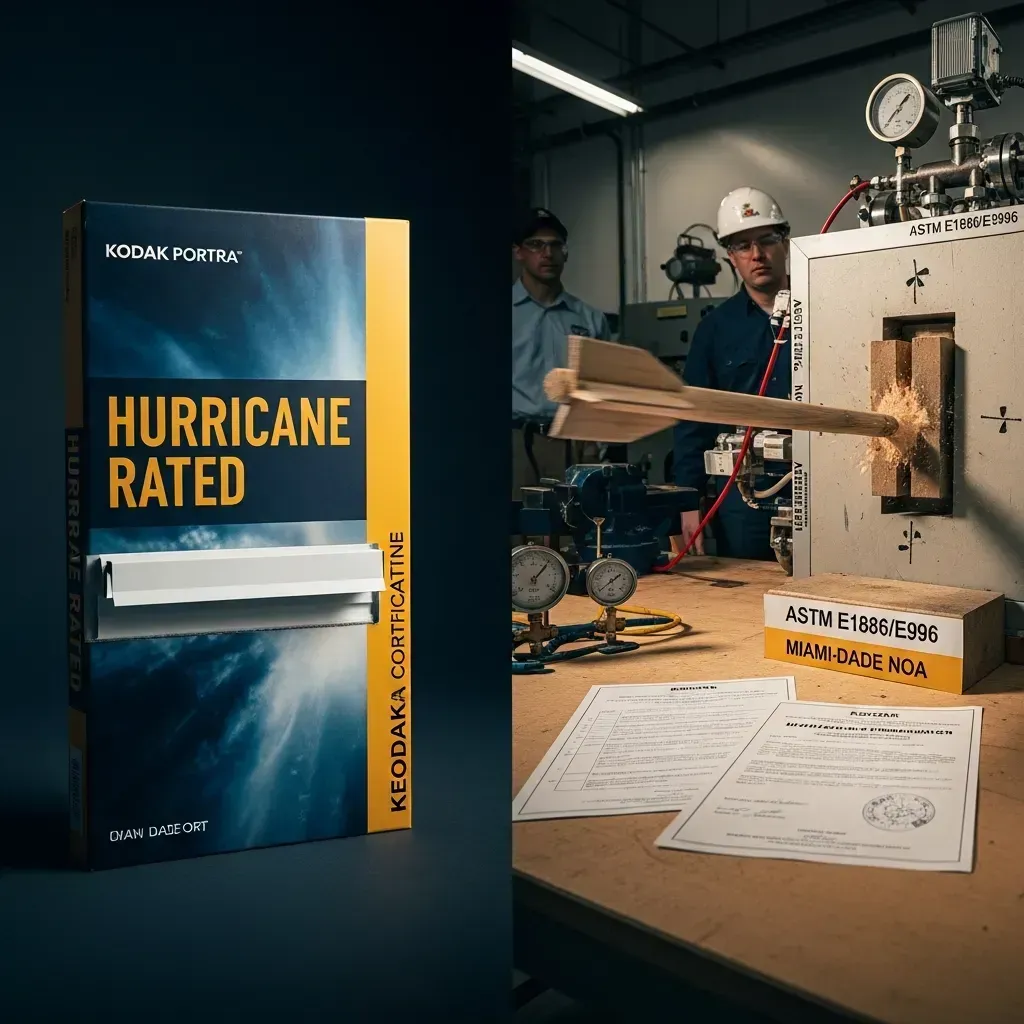
What 'Hurricane Rated' Actually Means: Testing Standards vs. Marketing Language
Decoding 'Hurricane Rated': What Testing Standards Actually Prove and What Marketing Language Hides
Three Words That Could Cost You Your House
"Hurricane rated."
Those two words appear on products ranging from adhesive window film
that costs a few hundred dollars to whole-home impact glass systems that
cost tens of thousands. They appear on marketing brochures, contractor
websites, product packaging, and social media advertisements. They sound
authoritative. They sound like they mean something specific and
verifiable.
They do not. "Hurricane rated" has no legal definition, no engineering
definition, and no regulatory definition. No government agency, building
code authority, or testing organization has ever established criteria
for using those words. Any manufacturer can print "hurricane rated" on
any product without passing a single test.
The same is true of "storm tested," "wind resistant," "hurricane
protection," and "hurricane defense." These are marketing phrases, not
engineering certifications. They describe what a company wants you to
believe about their product, not what an independent testing laboratory
has verified.
This matters enormously because the difference between a product that
has passed rigorous, independently verified hurricane testing and a
product that merely claims to be "hurricane rated" is the difference
between a building envelope that holds and one that fails. And as this
series has documented, that difference determines whether your home
sustains minor exterior damage or catastrophic interior destruction ---
and whether your insurance claim is straightforward or contested.
The testing landscape is genuinely confusing. It was designed for
building officials and engineers, not consumers. But homeowners spending
\$15,000 to \$50,000 on hurricane protection deserve to understand what
they are buying. This article decodes the three testing systems that
actually verify hurricane performance, identifies the marketing language
that should raise immediate concern, and gives you seven specific
questions to bring to any contractor consultation.
The Three Testing Systems That Actually Mean Something
When a product is genuinely tested for hurricane performance, that
testing follows one of three systems. Each has a specific name, a
specific standard number, and a publicly searchable database where any
homeowner can verify a product's certification.
ASTM E1886 / E1996: The National Standard
ASTM International --- formerly the American Society for Testing and
Materials --- publishes the two standards that form the national
baseline for hurricane impact testing. ASTM E1996 defines what a product
must withstand: the missile types, the missile sizes, the impact
velocities, and the wind zones. ASTM E1886 defines how the testing is
conducted: the test apparatus, procedures, and sequencing.
Together, these standards require a product to first survive missile
impact and then endure thousands of cycles of alternating positive and
negative air pressure that simulate sustained hurricane winds. The large
missile test fires a nine-pound two-by-four lumber section at the
product at speeds ranging from 34 to 80 feet per second, depending on
the wind zone and building height. Three specimens must be tested, with
impact locations at the center, one corner, and the opposite corner.
After impact, the product undergoes cyclic pressure loading that
simulates hours of sustained hurricane-force wind. To pass, the product
must prevent penetration during impact and maintain structural integrity
through the entire pressure cycle without creating an opening that
compromises the building envelope.
ASTM E1996 was first published in 1999 and is referenced in the
International Building Code and the 2023 Florida Building Code. Products
that pass this testing can earn a Florida Building Code Product
Approval, which is publicly searchable at the Florida Building
Commission's product approval database.
Miami-Dade TAS 201 / 202 / 203: The Most Stringent Standard in the Country
Miami-Dade County created its own testing protocols after Hurricane
Andrew devastated South Florida in 1992, exposing catastrophic failures
in building products that were supposed to withstand hurricanes. The
result is the TAS (Testing Application Standard) system, which exceeds
national ASTM standards in several critical areas.
TAS 201 tests impact resistance using the same large missile --- a
nine-pound two-by-four at 50 feet per second --- but applies it within a
testing sequence that is more demanding than the ASTM protocol alone.
TAS 202 evaluates structural load performance, water infiltration, air
infiltration, and in some cases forced-entry resistance. TAS 203
subjects the product to 9,000 cycles of alternating positive and
negative pressure at 1.5 times the design pressure --- simulating a
sustained Category 4 to 5 hurricane, not a single gust.
Products that pass all three TAS protocols earn a Miami-Dade Notice of
Acceptance --- the NOA. This is the single most stringent product
certification in the hurricane protection industry. Each NOA is assigned
a unique number, must be renewed annually, and requires ongoing
manufacturing facility inspections and quality assurance testing. The
NOA is publicly searchable at the Miami-Dade County Product Control
Division website.
A critical distinction: a Miami-Dade NOA is accepted statewide in
Florida and is recognized in many other hurricane-prone jurisdictions.
It is the gold standard not because it is required everywhere, but
because it certifies that a product has passed the most rigorous testing
available.
Florida Product Approval: The Statewide System
Florida's statewide Product Approval system certifies that a product
meets the Florida Building Code. For products intended for use in the
High-Velocity Hurricane Zone --- Miami-Dade and Broward counties --- the
Product Approval requires the same TAS testing as the Miami-Dade NOA.
For products used outside the HVHZ, testing may follow ASTM standards at
lower thresholds. Both certification types are searchable in the same
Florida Building Commission database. When evaluating a product, check
whether its Florida Product Approval specifies HVHZ compliance or
standard wind zone compliance --- the difference in testing rigor is
significant.
What Does 'Hurricane Rated' Actually Mean?
"Hurricane rated" has no legal, engineering, or regulatory definition.
Any manufacturer can use this phrase without passing any standardized
test. The certifications that do verify hurricane performance are ASTM
E1886/E1996 (the national testing standard for wind-borne debris impact
and cyclic pressure), Miami-Dade TAS 201/202/203 (the most stringent
testing protocol in the country, required in Florida's High-Velocity
Hurricane Zone), and Florida Building Code Product Approval (the
statewide certification system). Products with genuine hurricane
certification carry a specific approval number --- either a Miami-Dade
NOA number or a Florida Product Approval number --- that is publicly
searchable in government databases. If a product claims to be "hurricane
rated" but cannot provide a verifiable certification number, the claim
is marketing language, not engineering verification.
The Decoder Ring: Marketing Language vs. Engineering Language
Once you understand what the real certifications look like, the
marketing language becomes easier to identify. Here is what to watch
for.
Phrases that sound official but are not: "Hurricane rated," "storm
tested," "wind resistant," "hurricane grade," "hurricane proof," and
"storm strength" are all marketing phrases with no standardized
definition. A product can carry any of these labels without passing ASTM
E1886/E1996, TAS 201/202/203, or earning any form of building code
product approval. The presence of these phrases without an accompanying
certification number is a red flag, not a reassurance.
Wind speed claims without context: A product that claims to be
"rated for 150 mph winds" may be describing a pressure test, not an
impact test. Wind pressure resistance and wind-borne debris impact
resistance are fundamentally different things. A product can resist the
air pressure generated by 150 mph winds while being completely
vulnerable to a piece of roofing tile or lumber traveling at a fraction
of that speed. The question is not only what wind speed the product
withstands, but whether it has been tested with actual debris impact at
that wind speed.
"Tested" without specifying which test: The word "tested" alone is
meaningless. Every manufactured product is tested in some fashion during
production. The question is tested to which standard, by which
laboratory, and with what result. A legitimate certification will
specify ASTM E1886/E1996, TAS 201/202/203, or both. It will reference a
specific Florida Product Approval number or Miami-Dade NOA number. If a
contractor or manufacturer cannot provide these specifics, the testing
claim should be treated with skepticism.
Laboratory results that are not independently verified: Some
manufacturers conduct in-house testing and present the results as
certification. In-house testing is not independent verification. The
ASTM and TAS testing systems require testing at accredited, third-party
laboratories. The Miami-Dade NOA system additionally requires ongoing
manufacturing facility inspections, annual product audits, and market
surveillance testing. A product that has only been tested in-house has
not been independently certified, regardless of the results.
What Is ASTM E1996 Testing?
ASTM E1996 is a national testing specification published by ASTM
International that defines performance requirements for windows, doors,
and hurricane protection systems exposed to wind-borne debris during
hurricanes. The standard specifies missile types and impact velocities
that simulate real hurricane debris: the large missile test uses a
nine-pound two-by-four lumber section fired at 34 to 80 feet per second
depending on wind zone and building height. Testing follows the ASTM
E1886 test method, which requires three specimens to be impacted at
three locations (center and both corners), then subjected to thousands
of cycles of alternating positive and negative pressure simulating
sustained hurricane winds. Products that pass earn eligibility for
Florida Building Code Product Approval. ASTM E1996 is referenced in both
the International Building Code and the 2023 Florida Building Code.
What Is a Miami-Dade NOA?
A Miami-Dade Notice of Acceptance (NOA) is the most stringent product
certification for hurricane protection in the United States. Issued by
the Miami-Dade County Product Control Division, the NOA certifies that a
product has passed TAS 201 (large missile impact), TAS 202 (structural
load, water infiltration, air infiltration), and TAS 203 (9,000 cycles
of alternating pressure at 1.5 times design pressure). This testing
protocol exceeds national ASTM standards and simulates sustained
Category 4 to 5 hurricane conditions. Each NOA is assigned a unique
number (e.g., NOA 21-0612.08), must be renewed annually, and requires
ongoing third-party manufacturing inspections. The NOA is accepted
statewide in Florida and recognized in many other hurricane-prone
jurisdictions. Any homeowner can verify a product's NOA status at the
Miami-Dade County Product Control search portal.
Seven Questions to Bring to Every Contractor Consultation
Print these. Bring them. Ask them. The answers will tell you whether you
are dealing with a contractor who understands hurricane certification or
one who is relying on marketing language.
1. What is the Florida Product Approval number or Miami-Dade NOA number for this product?
A good answer is a specific number that can be looked up in a public
database. A red flag is hesitation, deflection, or a claim that the
product is "hurricane rated" without a verifiable number.
2. Which specific ASTM and TAS standards was this product tested to?
A good answer references ASTM E1886/E1996 and, for HVHZ-rated products,
TAS 201/202/203. A red flag is vague references to "wind testing" or
"laboratory testing" without naming the standard.
3. Was the testing conducted by an independent, accredited third-party laboratory?
A good answer names the laboratory. A red flag is in-house testing
presented as certification.
4. Will this installation qualify for wind mitigation credits on my insurance?
A good answer is yes, with an explanation of the wind mitigation
inspection process and which credits the installation will earn. A red
flag is uncertainty about insurance implications or a claim that "most
insurers" accept the product without specifics.
5. Does the certification cover the specific sizes and configurations being installed on my home?
A good answer confirms that the product approval or NOA covers the exact
sizes being proposed. A red flag is a certification that covers only
specific test sizes that differ from what is being installed.
Certifications specify maximum spans and configurations --- products
installed outside the certified parameters are not covered by the
approval.
6. What does the warranty cover, for how long, and what voids it?
A good answer provides specific durations for fabric, frame, motor, and
installation, with clear exclusions. A red flag is vague warranty
language or a warranty that requires the manufacturer's own installers
for future service.
7. Can I see a completed installation on a similar home, and can I speak with that homeowner?
A good answer is an immediate yes with a specific address and contact. A
red flag is an inability to provide references or an offer of only
manufacturer-provided testimonials.
What Questions Should I Ask a Hurricane Protection Contractor?
Ask seven specific questions:
(1) What is the Florida Product Approval or Miami-Dade NOA number?
(2) Which ASTM and TAS standards was the product tested to?
(3) Was testing conducted by an independent, accredited laboratory?
(4) Will the installation qualify for wind mitigation insurance credits?
(5) Does the certification cover the exact sizes and configurations being installed?
(6) What does the warranty cover, for how long, and what voids it?
(7) Can I see a completed installation and speak with the homeowner?
Legitimate contractors will answer all seven with specifics. Any contractor who cannot provide a
verifiable certification number, names only marketing phrases instead of
testing standards, or deflects questions about independent testing
should be evaluated with caution.
What You Can Verify Tonight
If you have already received a quote or proposal for hurricane
protection, pull it out now. Look for a Florida Product Approval number
or a Miami-Dade NOA number. If one is listed, search it in the
corresponding public database. Verify that the approval is current, that
it covers the product being proposed, and that the approved sizes match
the sizes being installed on your home. If no certification number is
listed, that is information worth having before you sign a contract.
If you have existing hurricane protection already installed, the same
verification applies. Products installed years ago may have been
certified under earlier standards or may not have been certified at all.
Knowing what you have is the first step toward knowing whether it will
perform when it matters.
You now have the engineering knowledge from the previous article and the
certification literacy from this one. The next article in this series
brings both to the most vulnerable and most valuable space on your
property: the outdoor living areas --- lanais, pool cages, outdoor
kitchens, and screened enclosures --- where the investment is largest
and the structural exposure is greatest.